Kaen Magazin
What is Damascus steel and why does it cut better?
Layers, hardness, pattern and edge: what actually makes a Damascus steel knife different, explained without myths and with numbers.
Kaen6 Min. Lesezeit
Ask what Damascus steel is and you will usually get the pretty half of the answer: the waves, the pattern, the legend of the swords of Damascus. All true, and all the least useful half. The other half is what you feel when you slice an onion: how hard the steel is, how acute the edge is, and how long it takes before the knife needs sharpening. This article covers both.
What Damascus steel actually is
Modern Damascus steel is a laminated steel: several layers of steel with different compositions are stacked, heated and forge-welded into a single block. That block is folded and forged again several times. Every fold doubles the number of layers, which is why knives talk about 33, 67 or 101 layers.
In a well-made kitchen knife those layers are not decoration. The usual structure is a hard steel core (the part that becomes the edge) wrapped in softer, more flexible layers. The core holds the edge; the wrap keeps the core from snapping and gives the whole blade some give. It is the same logic as a Japanese sword: hard where it cuts, tough where it takes the hits.
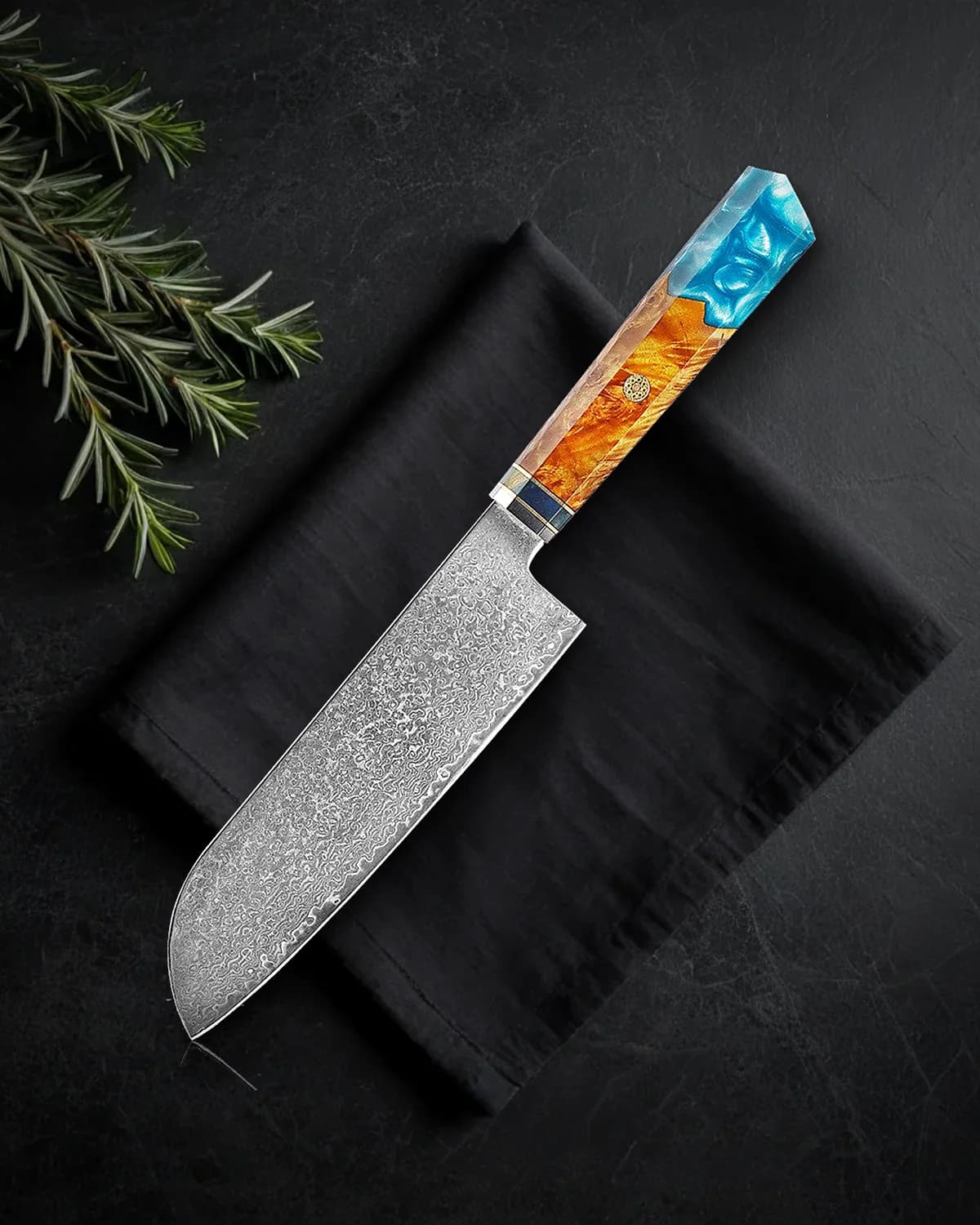
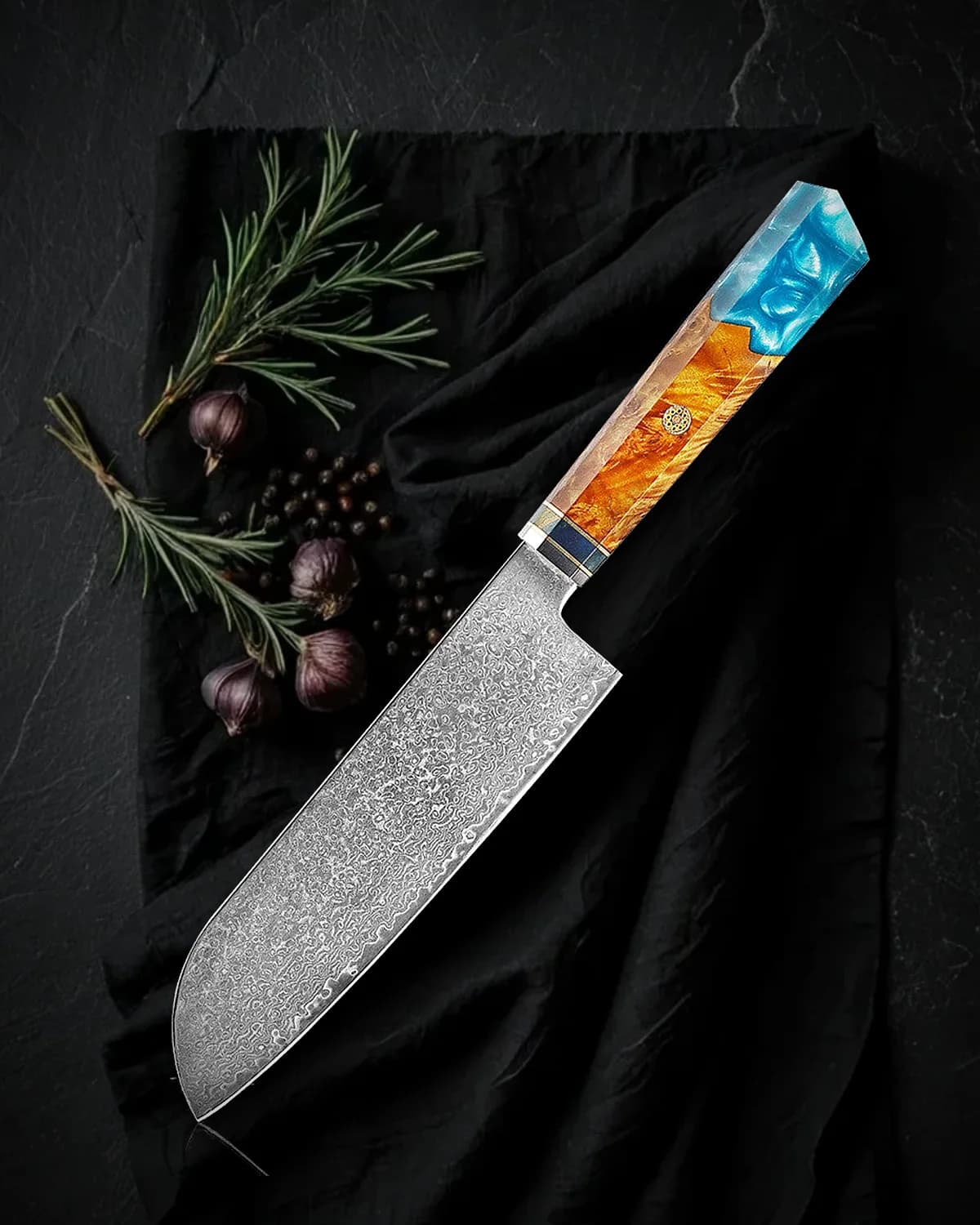
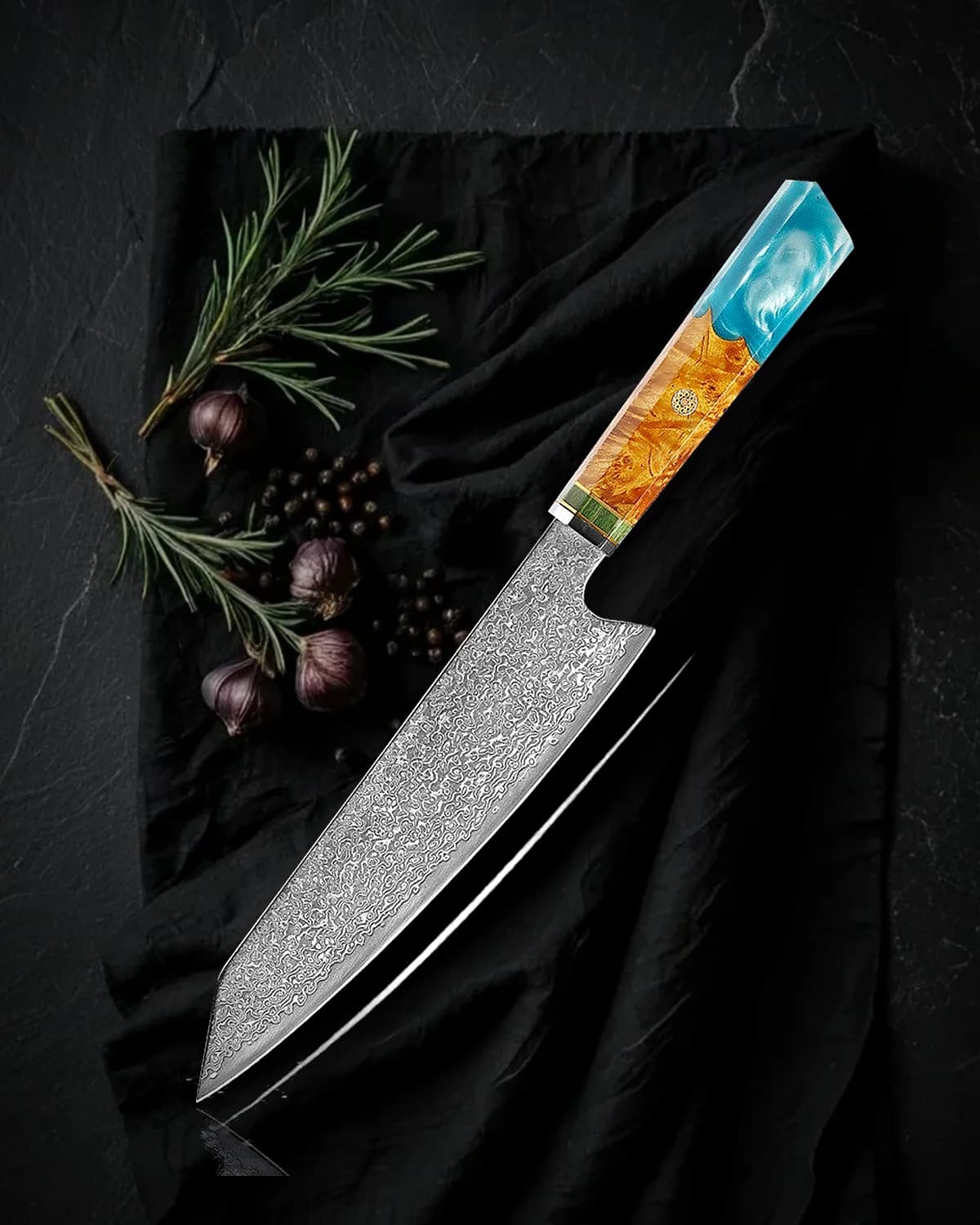
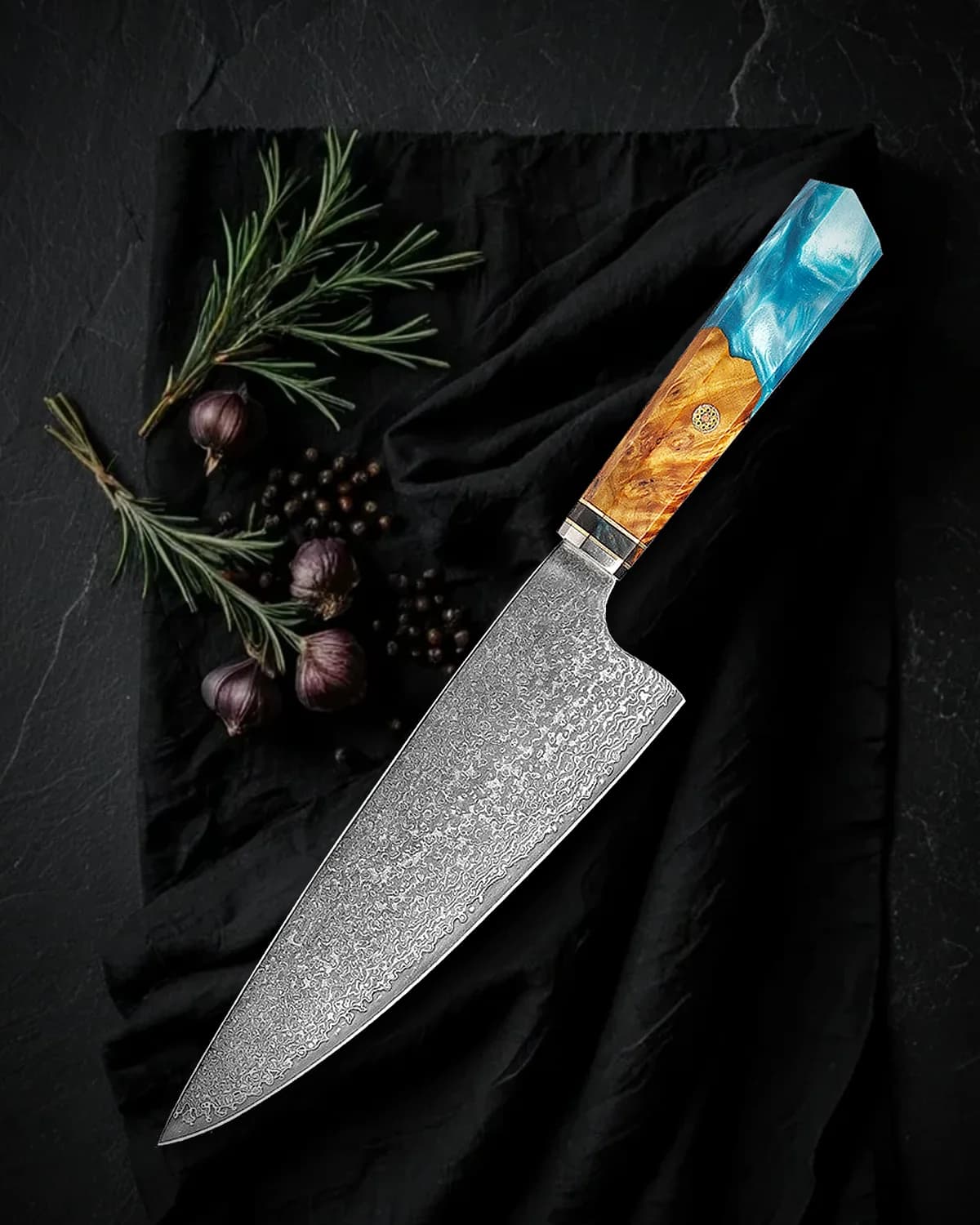
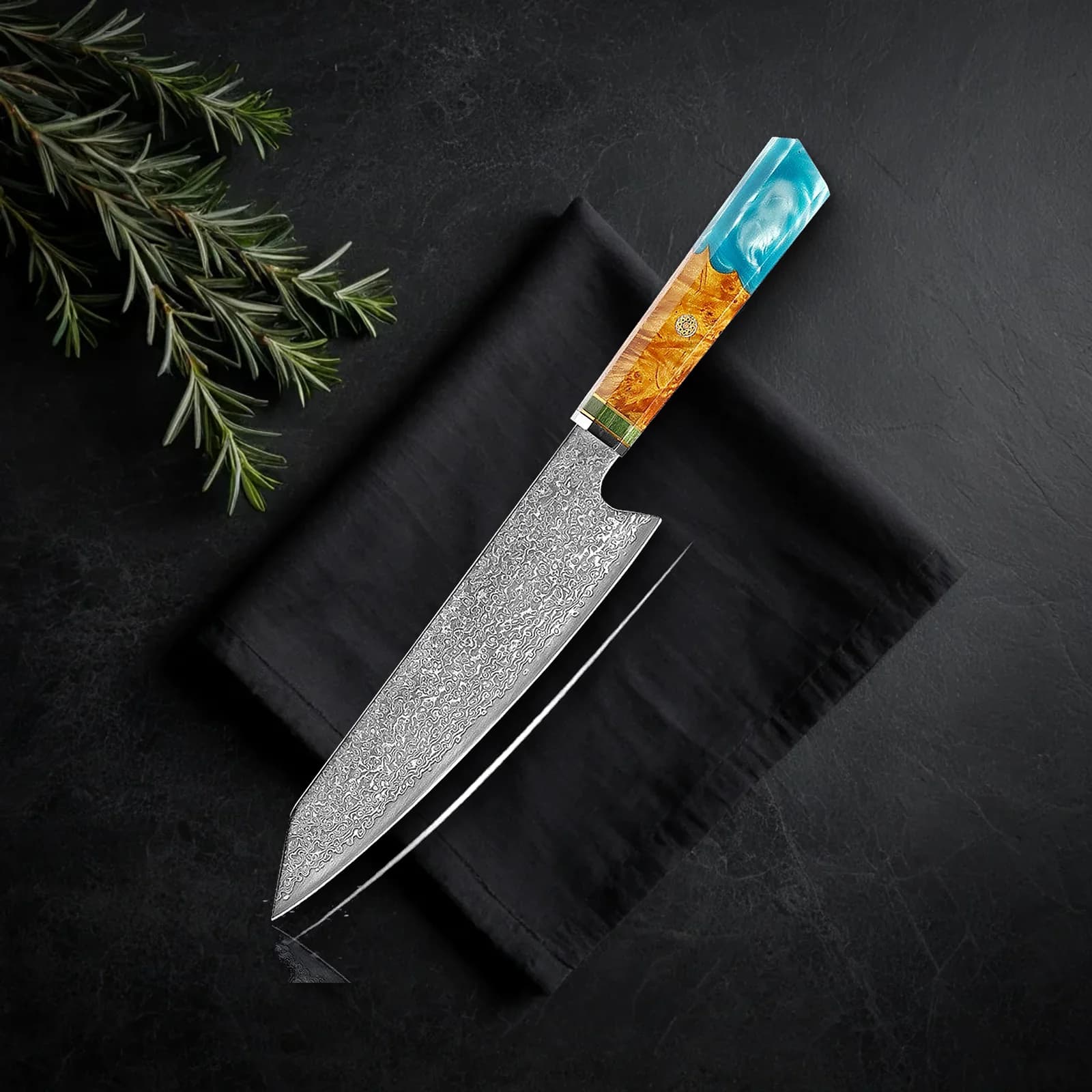
Kaen knives use a high-carbon stainless core with 67 layers of Damascus steel and a hardness of 60 to 62 HRC. Here is what that means.
Hardness: the number that explains almost everything
Steel hardness is measured on the Rockwell C scale (HRC). The higher it is, the harder the steel and the longer it holds an edge, because the metal neither bends nor wears with use.
| Knife type | Typical hardness | Weeks between sharpenings |
|---|---|---|
| Supermarket knife | 52–54 HRC | 1–2 |
| Classic German knife | 56–58 HRC | 3–5 |
| Japanese Damascus steel knife | 60–62 HRC | 8–12 |
A knife at 52 HRC is easy to sharpen, but the edge rolls after a few days of use: that is why cheap knives "go blunt" so fast. At 60–62 HRC the edge lasts for weeks, and when you do sharpen it on a stone it comes back like new. The trade-off is that very hard steel is more brittle: it is not the knife for splitting bones or opening cans. For everything else, it is another world.
Why Damascus steel cuts better
This is the key, and it is not the pattern. A knife cuts better because of three things that Damascus steel allows you to do well:
- A more acute edge angle. Hard steel takes a 12–15° edge per side without rolling. A German knife runs at 17–20° and a supermarket knife at 22–25°. A smaller angle is literally less metal that has to push its way through: you cut with less force and without crushing the food.
- A thinner blade. Because the outer layers make the steel tough, the blade can be thinner. A thin blade separates fibres instead of tearing them: tomatoes do not squash, onions make you cry less, fish comes off clean.
- Edge retention. As above: weeks instead of days.
The wavy pattern is the visible consequence of the layers, not the cause of the cut. A laser-etched pattern on soft steel cuts like soft steel. If you want to tell them apart, we explain it in how to tell if a Damascus knife is real.
The pattern: why no two knives are alike
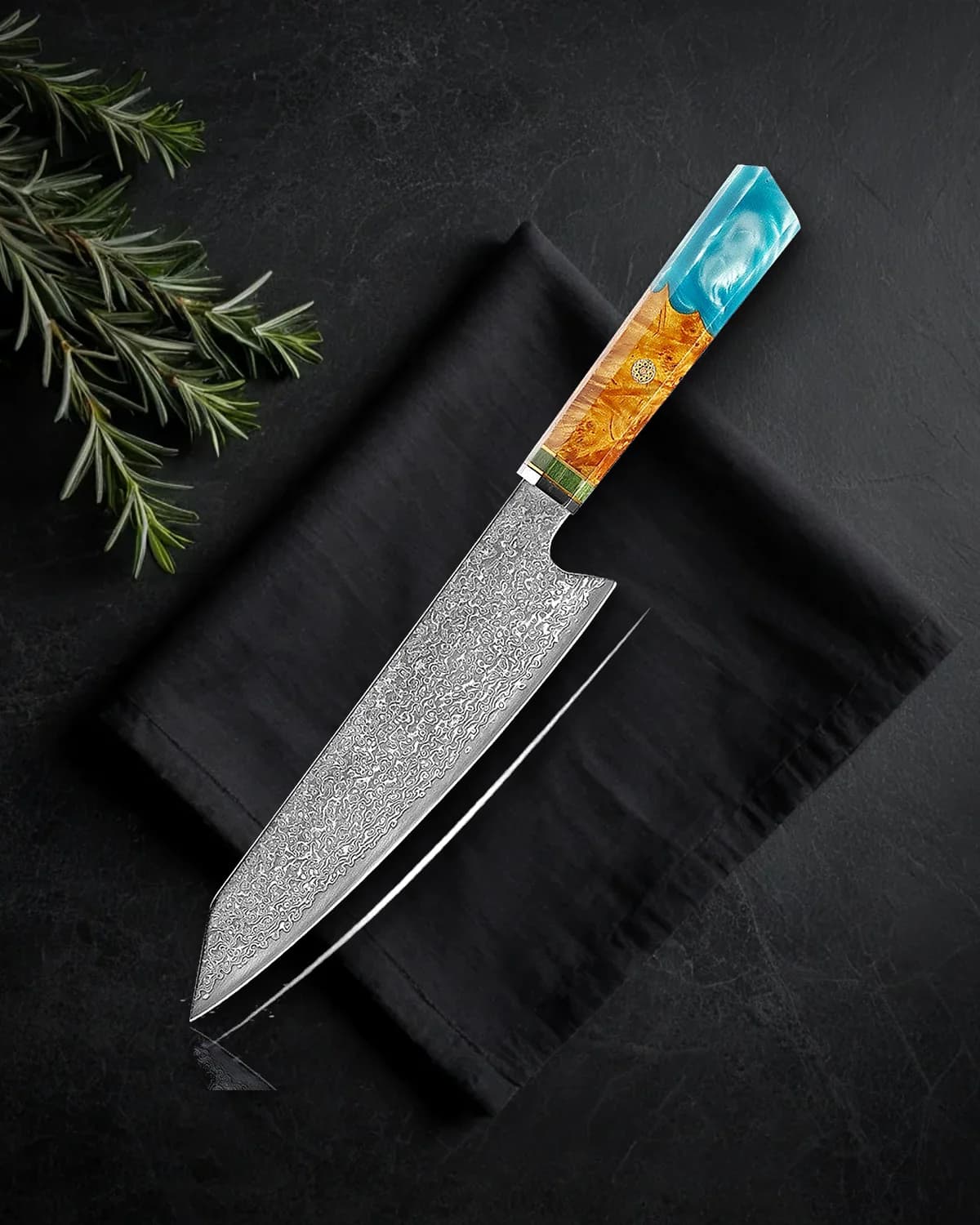
When the laminated block is forged, folded and ground, the layers are exposed on the surface in wavy shapes. They are then etched with a mild acid that darkens one steel more than the other, and the pattern appears. Because folding and grinding are never identical, every blade has a unique pattern, like a fingerprint.
The pattern is also a quality clue: on real Damascus the waves follow the edge and change shape at the spine and the tip, because the layers are cut at different angles. On an etched knife the pattern is equally sharp everywhere and repeats.
Historical Damascus and modern Damascus
The name comes from Damascus, the city through which blades of wootz steel, an Indian crucible steel with a carbide pattern, entered Europe. That technique was lost around the 18th century. What we call Damascus steel today is pattern-welded steel: a different process, the same spirit, better steels. Modern Damascus with a stainless core is infinitely easier to look after than a historical blade: it does not rust from a drop of water and does not need oiling every day.
Japanese Damascus steel: what sets it apart
Japan inherited laminated forging from the sword and applied it to the kitchen knife. A Japanese Damascus knife stands out for:
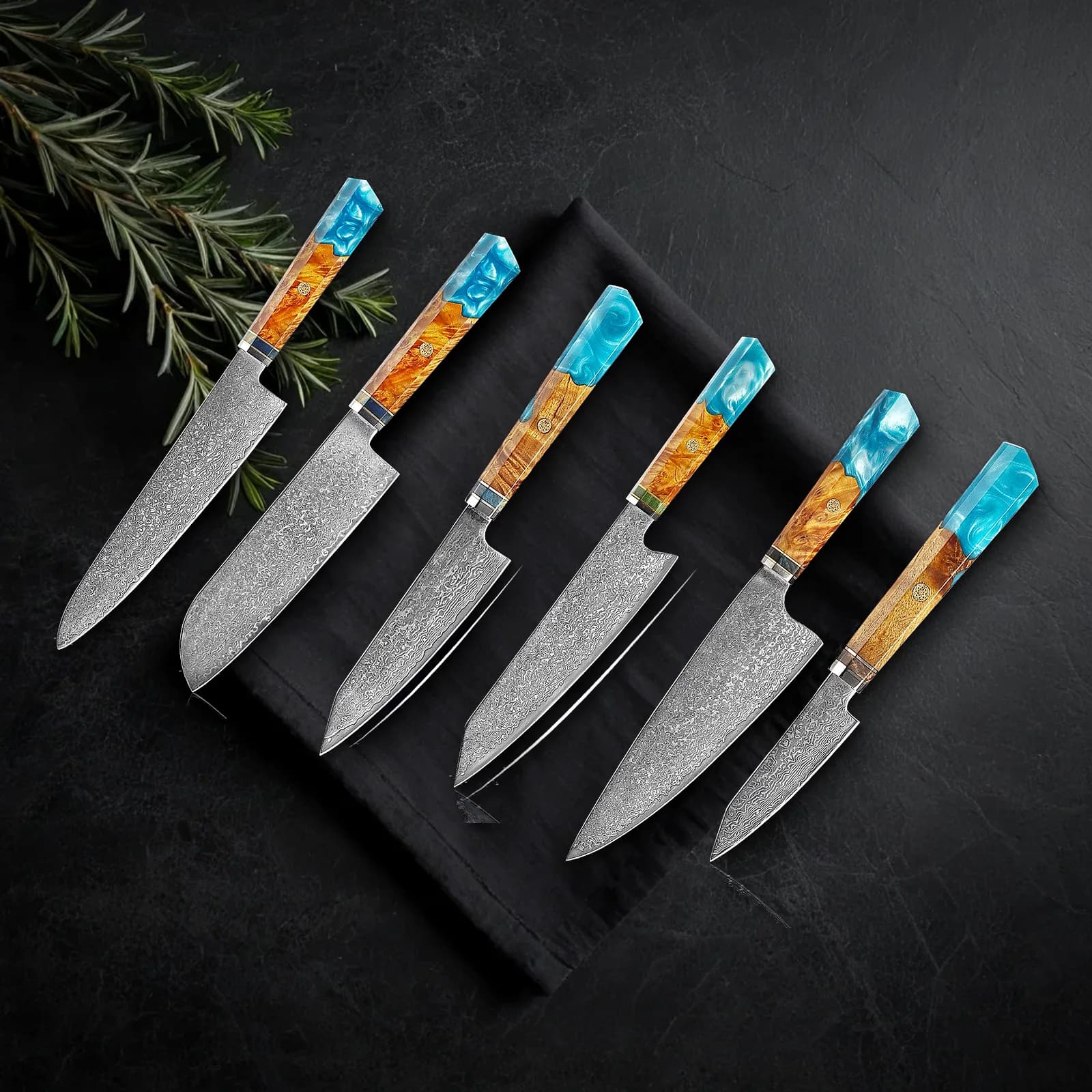
- A specific shape for every job: the Gyuto (chef), the Nakiri (vegetables), the Santoku (all-purpose), the Bunka, the Kiritsuke and the Petty. No "one knife for everything": each shape solves one kind of cut. We compare them in Gyuto vs Santoku.
- An octagonal or D-shaped handle, light, which balances the blade forward. Kaen knives have an octagonal handle of resin and stabilised wood: a firm grip with wet hands and no absorbed smells.
- Less weight: a 20 cm Gyuto weighs around 200–340 g against 250–350 g for an equivalent German chef knife, and the weight sits in the blade, not the handle.
What Damascus steel is not
So nobody sells you hype:
- It is not indestructible. Steel at 61 HRC chips if you use it on glass or marble, put it in the dishwasher or try to split a bone. A wooden board and hand washing, and it lasts a lifetime. The four habits are in the care guide.
- It is not magic because of the layer count. 67 well-forged layers cut better than 300 layers of mediocre steel. The number matters less than the core steel and the heat treatment.
- It does not replace sharpening. It lasts far longer, but every few months a 1000/6000 water stone brings back the factory edge in ten minutes. Step by step in the sharpening guide.
How to choose your first Damascus steel knife
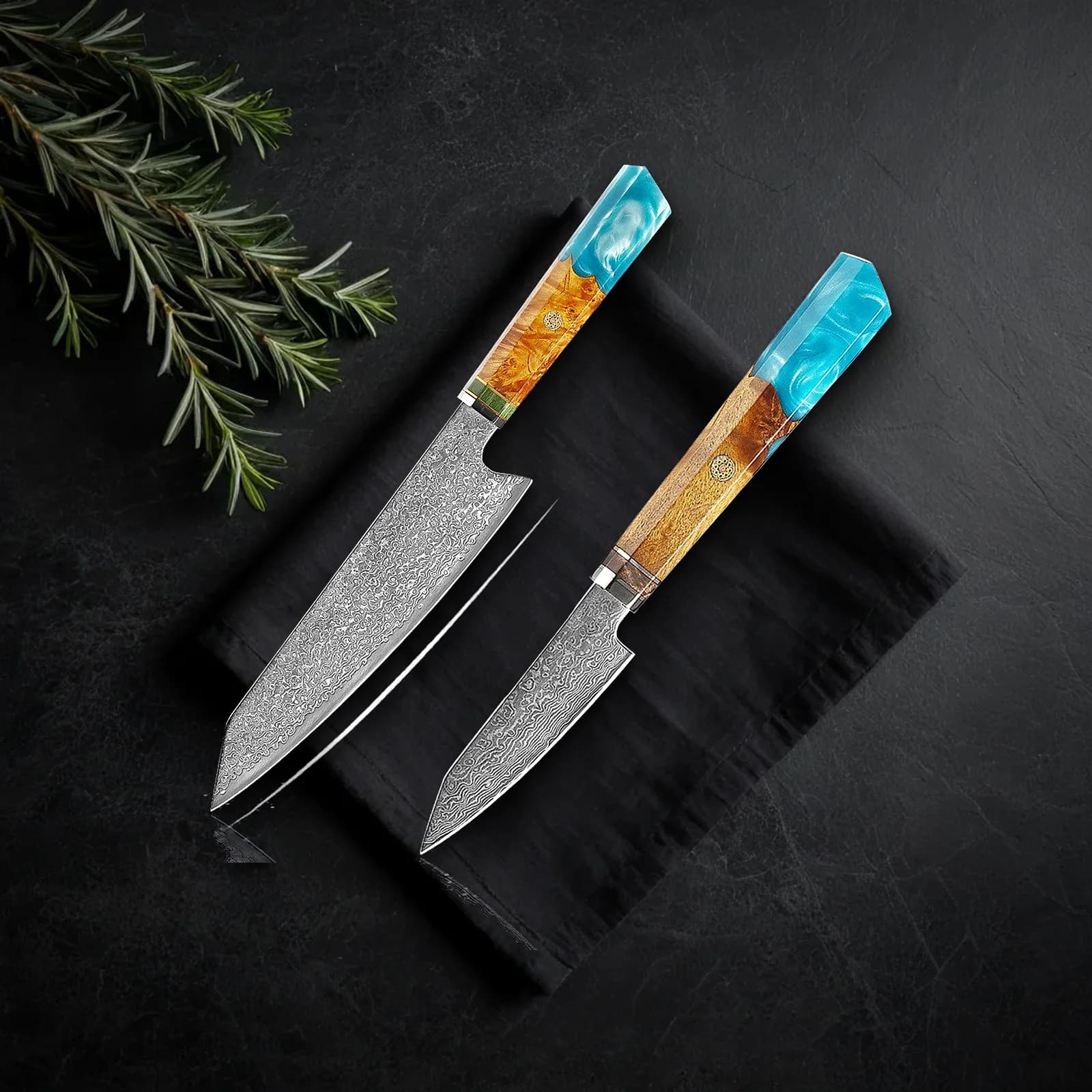
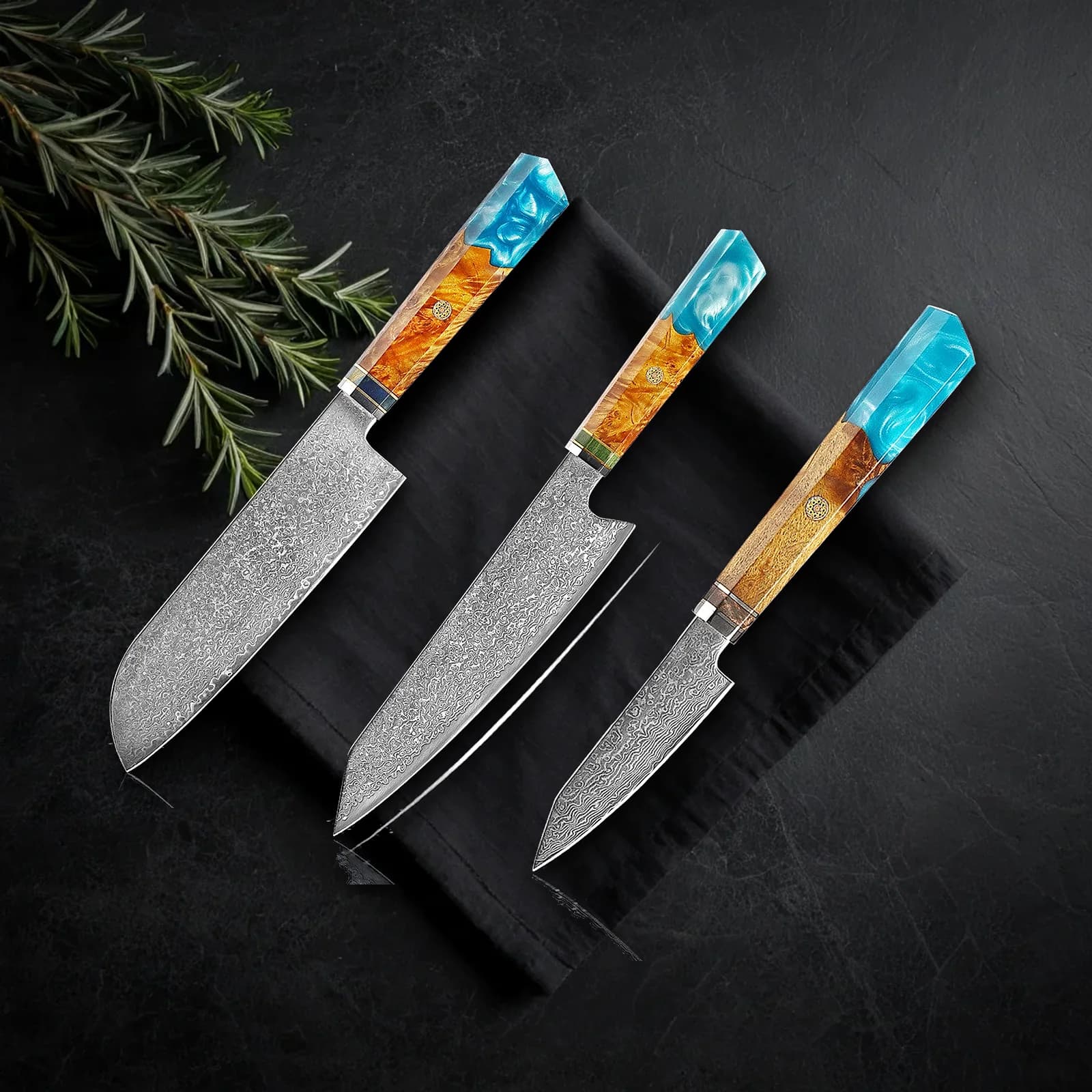
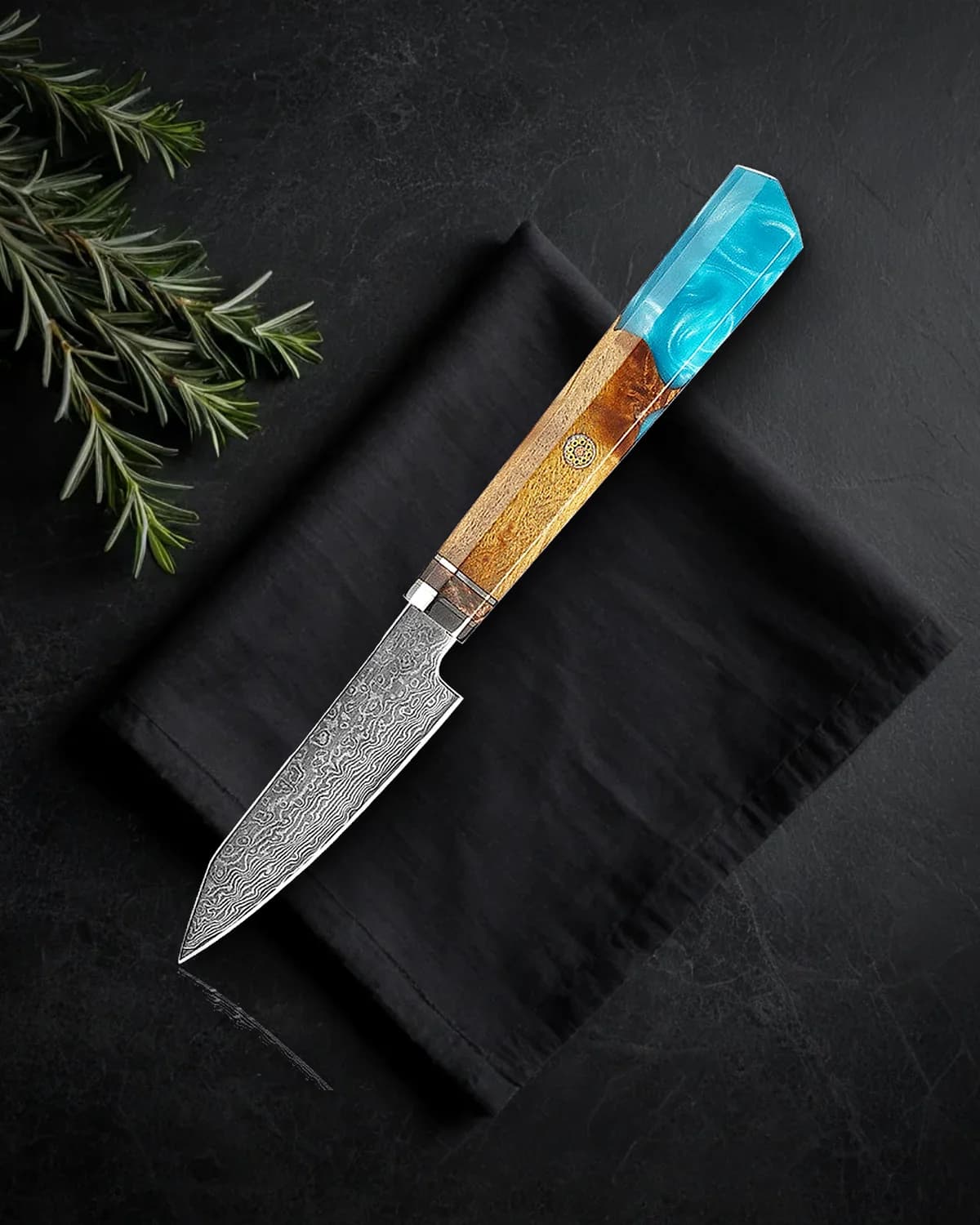
If you are going to own one, make it a 20 cm Gyuto: it does 80% of the work in any kitchen. If you are going to own two, add a 9 cm Petty for peeling, turning and details. If you want to cover 100% of what you cook, the Gyuto + Nakiri + Petty trio is the combination we recommend to almost everyone: it is exactly the Complete Set, and it costs 69.90 € less than the three knives bought separately.
Still torn between shapes? The guide to choosing a Japanese knife walks you through it.
Häufige Fragen
- Is Damascus steel stainless?
- Modern Damascus is, when both the core and the layers are high-carbon stainless steel (as in Kaen knives). Even so, wash by hand and dry right away: prolonged moisture and the dishwasher dull the pattern and can pit the edge.
- How many layers should a good Damascus steel knife have?
- Between 33 and 101 is usual for quality kitchen knives; Kaen knives have 67. More layers does not mean a better cut: what cuts is the core steel (60–62 HRC) and the edge angle (12–15°).
- How long does the edge of a Damascus knife last?
- With daily home use, 8 to 12 weeks before it needs the stone, against 1–2 weeks for a supermarket knife. A pass on a honing rod every few weeks stretches that further.
- Is a Damascus steel knife worth it for home cooking?
- If you cook several times a week, yes: you cut with less effort, the food looks better and you sharpen four times less often. If you would only use it once a month, a well-sharpened ordinary knife will do.